



16
Feb
Feb

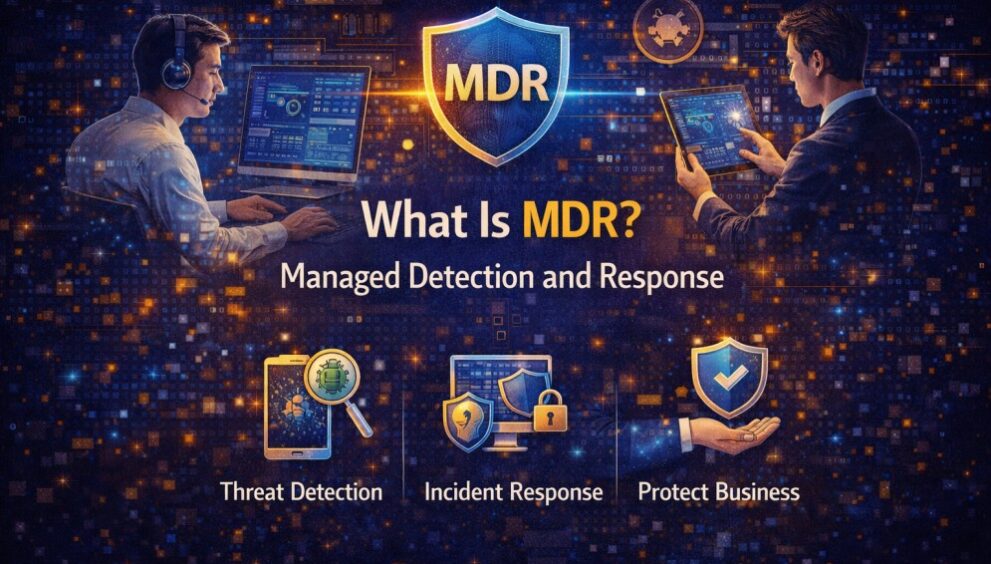
What Is MDR? Managed Detection and Response
-
knowlegde-centre / 1 month
- February 16, 2026
- 0

Cyber attacks rarely announce themselves anymore. A suspicious login at midnight, a silent script running on a laptop, or an employee clicking a convincing phishing link can be enough to put your data, operations, and reputation at risk. If you rely only on basic anti-fraud virus software or occasional log reviews, you are often reacting after the damage has started.
In this article, you will learn what MDR is, how it works, its benefits, key comparisons, and how to choose.
What Is MDR?
What is MDR in cybersecurity? MDR, which stands for managed detection and response, is straightforward: it’s a managed security service that monitors your environment, detects suspicious activity, investigates alerts, and responds to incidents on your behalf.
Key building blocks you typically see in managed detection:
- Unified visibility across endpoints, identities, cloud, and network signals
- Behaviour-based detection to reduce reliance on known signatures
- Human-led investigation to cut through noise and false positives
- Clear response actions to contain, remove, and recover from threats
How MDR Works?
At its core, MDR is monitoring, detection and response delivered as a managed service. Your security data is continuously collected, analysed, and triaged, often alongside signals from your existing antivirus software, and the provider then takes action based on agreed playbooks, so you are not left staring at alerts.
1. 24/7/365 Monitoring, Investigation, and Response
Threats do not follow office hours. MDR security services keep watch round-the-clock, investigate what matters, and help you respond quickly, even when your internal team is offline.
2. Proactive Remote Response
Good MDR services do not stop at “we found something.” They can remotely guide or execute containment steps, such as isolating a device, blocking a risky login, or stopping suspicious processes.
3. Unified Telemetry
MDR works best when signals come from multiple sources, not just a single tool. Unified telemetry means correlating endpoint, network, cloud, and identity activity so that a single red flag does not go unnoticed.
4. Expert Security Analysts
Tools can surface patterns, but people connect the dots. MDR providers use security analysts who can validate incidents, reduce false alarms, and explain what happened in plain language.
5. Advanced Threat Detection
Modern attacks often avoid obvious malware files. MDR cybersecurity typically uses behaviour analysis and threat-hunting techniques to detect stealthy activity that basic defences can miss.
6. Threat Intelligence
Threat intelligence strengthens detection by adding knowledge of known attacker infrastructure and techniques. It helps your MDR security team recognise patterns earlier and prioritise high-risk signals, while cybersecurity awareness reduces the chances of users falling for common lures.
7. Proficient Incident Response
Once something is confirmed, MDR focuses on containment, eradication, and recovery. You also get reporting that supports audits, internal reviews, and future hardening.
8. Benefits of MDR
The biggest benefit of managed detection and response is that you are not forced to choose between “doing nothing” and “building a full in-house SOC.” You get stronger security coverage without carrying the full operational load.
9. Around-the-Clock Coverage
Round-the-clock monitoring reduces blind spots, especially for distributed teams. You get faster detection of suspicious behaviour across laptops, servers, and cloud services.
10. Reduced Risk
MDR helps reduce risk by identifying real incidents sooner and guiding responses that limit their spread. This matters for ransomware-style disruptions and account takeovers.
11. Cost-Effective Cybersecurity
Building deep security capability internally is expensive and hard to scale. MDR services let you access tools and expertise on demand, often making budgeting simpler.
12. Improved Compliance
Continuous monitoring and structured incident handling can help meet compliance requirements, especially when audit trails, alert reviews, and response discipline are required.
13. Decreased IT Burden
Instead of your IT team chasing every alert, MDR filters noise and escalates what truly matters. That frees your team to focus on business priorities.
14. Enhanced Security Expertise
MDR gives you access to experienced analysts, threat hunters, and response specialists. This is particularly useful when hiring and retaining security talent is challenging.
MDR vs Other Security Solutions: What’s the Difference?
If you are comparing MDRs versus other tools, the key difference is simple: MDR is a managed service with people and response, while many other options are platforms or products you operate yourself.
MDR vs. EDR
EDR is mainly a tool focused on endpoints. MDR can include EDR, but adds continuous monitoring, human investigation, and response support across your wider environment.
MDR vs. XDR
XDR extends visibility beyond endpoints into additional layers, including email, identity, and the cloud. MDR can use XDR tooling, but the differentiator is the managed team that investigates and responds on your behalf.
MDR vs SIEM
SIEM aggregates logs and supports correlation, but it often requires skilled staff to tune and operate. MDR typically uses SIEM-like data, along with analyst-led triage and response, so you are not left to manage it alone.
MDR vs MSSP
An MSSP may focus on managing security tools and sending alerts. MDR is generally more detection and response-driven, with deeper investigation and clearer incident-handling outcomes.
Choose the Right MDR Security Services
Choosing the right MDR provider is not about the fanciest dashboard. It is about whether the service will actually reduce your operational risk and response time.
Look for signs of real operational maturity:
- Clear scope and coverage: Ask what data sources they support and what security for devices looks like across endpoints, identities, cloud, and network.
- Response ownership: Confirm what actions they can take, what needs your approval, and how escalation works during a live incident.
- Noise reduction: You should see fewer, better alerts, not more. Ask how they handle false positives and how they tune detections to your environment.
- Reporting you can use: The output should help your IT and leadership teams make decisions, and support audits without drowning you in jargon.
- Fraud and user-risk readiness: If your business faces phishing, payment scams, or social engineering, ask how they help with antifraud signals and identity misuse patterns.
- Proof before purchase: Request an endpoint protection demo, or even an endpoint protection demo if the vendor labels it that way, focused on real incident workflows, not just product screens.
- Alignment with awareness efforts: MDR works best when paired with cybersecurity awareness training, including cybersecurity awareness programmes for non-technical staff, so fewer threats get in.
The Impact of MDR on Modern Cybersecurity Strategies
MDR has shifted how organisations build security programmes. Instead of depending only on preventive layers, you get a living detection-and-response capability that adapts as attackers change tactics. When you combine MDR security with sensible hygiene, such as patching, access control, and secure internet practices, you move closer to resilience: spotting suspicious activity early, limiting blast radius, and recovering with less disruption.
In a world where attacks blend malware, fraud, and identity abuse, managed detection and response gives you a faster, calmer way to stay in control.
Frequently Asked Questions
-
What does MDR mean?
MDR means managed detection and response. It is a cybersecurity service that provides continuous monitoring, threat detection, investigation, and incident response support, typically delivered by a specialist security team.
-
Who needs MDR?
You need MDR if you handle sensitive data, rely on cloud apps, support remote work, or lack the bandwidth to monitor alerts continuously. It is also useful if you want stronger protection beyond antivirus software and basic endpoint tools.
-
Is MDR right for small and enterprise-level organisations?
Yes, for smaller organisations, MDR services can provide enterprise-grade monitoring without building an internal SOC. For enterprises, MDR can extend coverage, reduce alert fatigue, and strengthen incident response across complex environments.
-
What should I look for in an MDR provider?
Look for proven investigation capability, transparent response actions, coverage across endpoints and identities, and reporting that your teams can act on. Also check onboarding support, escalation clarity, and whether they integrate with your existing stack.