


30
Jul
Jul

What Is Vishing and How to Spot a Fake Bank Call Instantly
- QuickHeal / 2 months
- July 30, 2026
- 0

Table of Contents
- What Is a Vishing Attack?
- How Cybercriminals Use Fake Bank Calls
- What are the signs of a Fake Bank Call
- Why Vishing Attacks Are Harder to Detect
- How to Protect Yourself from Voice Phishing
- What Should You Do If You Receive a Suspicious Call?
- How Quick Heal Helps Protect Against Vishing Attacks
- Frequently Asked Questions
A call from someone claiming to be your bank may seem routine, but it could be the beginning of a vishing attack. India’s cyber threats are already operating at an unprecedented scale.
According to the India Cyber Threat Report 2025, security systems recorded 369.01 million malware detections across 8.44 million endpoints, averaging 702 detections every minute, while behavior-based detections increased to 14.56%, showing how cybercriminals are adopting highly advanced tactics. Meanwhile, phone-based fraud continues to surge.
Truecaller’s India report found that Indians received 4,168 crore spam calls in 2025, including 770 crore fraud calls, highlighting the scale of voice phishing in India. Unlike phishing emails or fraudulent text messages, vishing attacks rely on live conversations, caller ID spoofing, and AI-powered voice cloning to create trust and urgency.
This guide explains how to identify a fake bank call, understand the tactics behind voice phishing in India, and protect yourself from phone fraud in India.
What Is a Voice Phishing Attack?
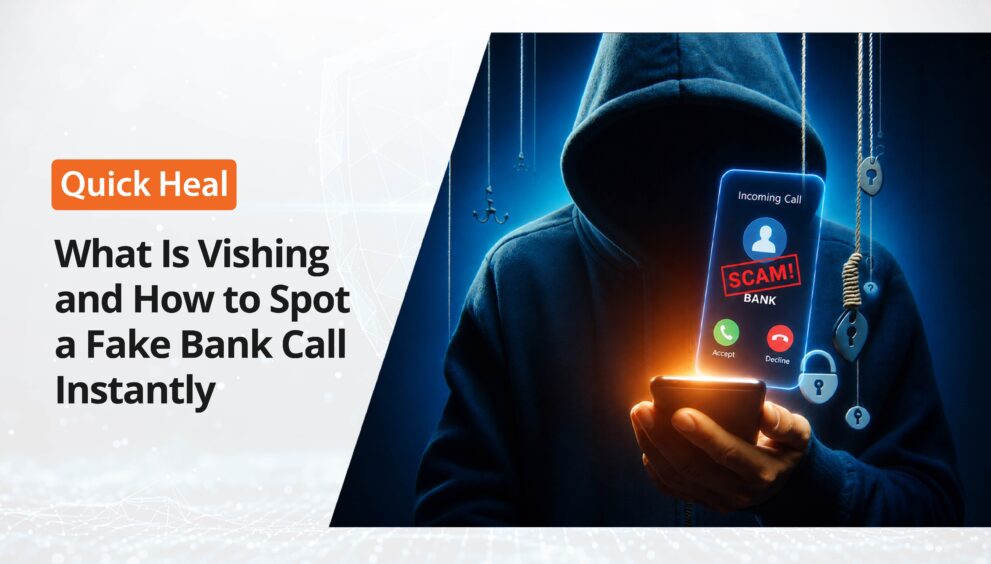
A vishing attack is a form of cyber fraud in which criminals use phone calls to impersonate trusted organisations and manipulate victims into sharing confidential information. Instead of sending malicious emails or fake websites, scammers rely on voice conversations to build trust and create panic. In voice phishing, fraudsters commonly pretend to represent:
- Banks and financial institutions
- RBI or government agencies
- Income Tax or GST departments
- Telecom operators
- Credit card companies
- Digital payment platforms
During a fake bank call, they may ask for OTPs, debit card details, CVV numbers, internet banking credentials, UPI PINs, or request that you install a remote access application. Genuine banks never ask customers to share such confidential information over the phone.
How Cybercriminals Use Fake Bank Calls
Most vishing attacks follow a similar pattern designed to exploit trust and urgency.
Initial Contact: You receive a call from what appears to be your bank’s official number.
Building Credibility: The caller already knows basic information such as your name, bank, or mobile number, making the conversation appear legitimate.
Creating Urgency: They claim your account has been blocked, a suspicious transaction has been detected, your KYC has expired, or your card will be deactivated.
Requesting Sensitive Information: The caller asks for your OTP, UPI PIN, debit card details, or asks you to install a screen-sharing application.
Financial Fraud: Once the information is shared, criminals gain access to your accounts or convince you to authorise fraudulent transactions.
The success of voice phishing in India lies in emotional manipulation. Fraudsters depend on fear, urgency, and authority to prevent victims from thinking critically before responding. A serious example comes from Mumbai, where a businessman lost Rs 4 lakh in 17 minutes after a fraudster posed as a Bank of Baroda employee, used his card details to sound credible, and repeatedly pressed him to share OTPs during the call.
What are the Signs of a Fake Bank Call
Recognising a fake bank call early can prevent financial loss.
Warning Sign | Why It Is Suspicious |
Caller demands immediate action | Creates panic to stop verification |
Requests OTP, PIN, or passwords | Banks never ask for these over calls |
Threatens account suspension | Uses fear to manipulate victims |
Asks you to install an app | Remote access apps can expose your device |
Requests payment to personal accounts | Genuine banks use official payment channels |
Promises rewards or refunds | Often used to lure victims into sharing information |
If any caller pressures you to act immediately or discourages you from verifying their identity, treat the call as suspicious.
Why Vishing Attacks Are Harder to Detect
Modern phone fraud in India extends far beyond traditional scam calls. Criminals now combine multiple techniques to make their attacks appear authentic.
Caller ID spoofing can display an official-looking bank number on your phone. AI-generated voices and voice cloning can imitate customer service representatives or even people you know. Fraudsters also exploit personal information shared online to personalise conversations and increase credibility.
Many scams now begin with a phone call but continue through WhatsApp, SMS, or email, directing victims to malicious websites or fake banking applications. This multi-channel approach makes a vishing attack much harder to identify than older forms of fraud.
How to Protect Yourself from Voice Phishing
Protecting yourself starts with following a few simple verification steps.
- Never share OTPs, UPI PINs, CVV numbers, passwords, or internet banking credentials over a phone call.
- Disconnect the call if someone creates urgency or threatens immediate account suspension.
- Call your bank using the official customer care number published on its website or your bank card.
- Avoid installing remote access or screen-sharing applications at a caller’s request.
- Verify unexpected banking requests through your branch or official mobile banking app.
- Enable transaction alerts and multi-factor authentication wherever available.
Remember, genuine financial institutions encourage customers to verify suspicious activity rather than act under pressure.
What Should You Do If You Receive a Suspicious Call?
If you suspect a vishing attack, act quickly.
- End the call immediately.
- Do not share any banking or personal information.
- Contact your bank through its official customer care number.
- Block the suspicious number.
- Report the incident through the National Cyber Crime Reporting Portal.
- Call the cybercrime helpline 1930 if you have already transferred money.
- Change your banking passwords if you believe any credentials have been compromised.
Prompt reporting can improve the chances of preventing further financial loss.
Conclusion
While awareness is the first line of defence against a vishing attack, security software can help reduce the risk of related cyber threats. Quick Heal Total Security, together with AntiFraud.AI, provides additional protection against phishing websites, malicious links, fraudulent applications, and other digital threats that often accompany voice phishing India scams.
Used alongside safe banking practices and careful verification, these tools add another layer of protection against increasingly sophisticated phone fraud in India.