




24
Aug
Aug

UPI Fraud Tactics Explained: 10 Scams That Target Indian Payments
- QuickHeal / 1 month
- August 24, 2026
- 0

Table of Contents
- 10 Common UPI Fraud Tactics Every User Should Know
- What Should You Do If You Become a Victim?
- How Quick Heal Helps Protect Your Digital Payments
- Final Thoughts
“₹1 has been credited to your account.” Moments later, you receive a call from someone claiming to be the buyer. They say the payment failed and ask you to scan a QR code or approve a “Collect Request” to receive the remaining amount. Trusting the request, you follow the instructions only to find money disappearing from your account instead.
This is how many UPI fraud cases unfold today. Rather than hacking banking systems, cybercriminals exploit trust and urgency to trick users into authorising payments themselves. As UPI processes billions of transactions every month, UPI scam India cases involving Google Pay fraud, PhonePe scam tactics and fake QR codes are becoming increasingly common.
Understanding these scams is the first step towards staying protected. Here are the ten most common UPI fraud tactics every digital payment user should know.
10 Common UPI Fraud Tactics Every User Should Know
1. Fake Collect Request Scam
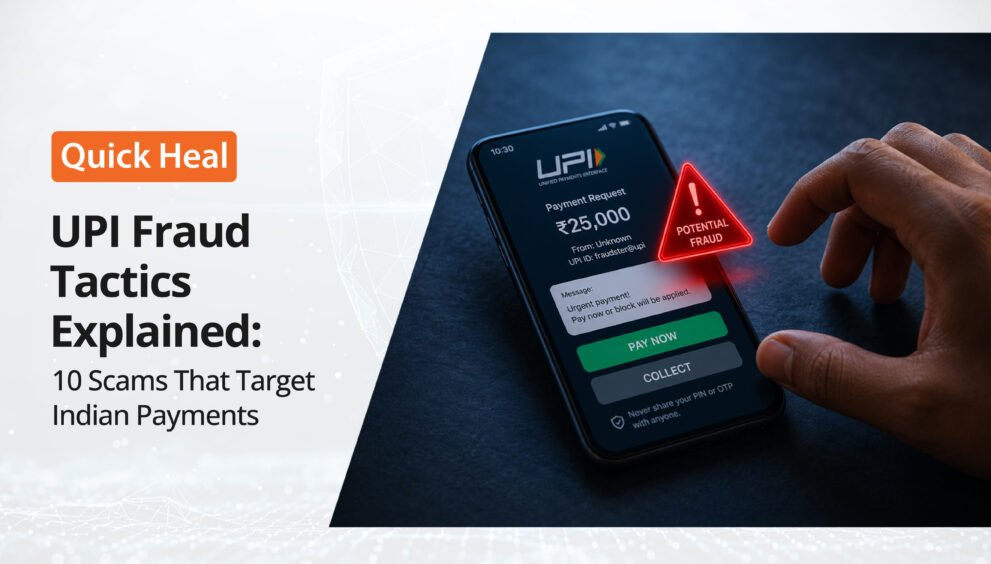
Instead of transferring money, fraudsters send a Collect Request and convince victims that approving it will help them receive a refund, salary or payment. Entering your UPI PIN authorises a debit from your account, not a credit.
Stay safe: Never approve a collect request unless you initiate it. Remember, receiving money never requires your UPI PIN.
2. QR Code Payment Scam
One of the biggest myths is that scanning a QR code is required to receive money. Fraudsters posing as buyers often send fake QR codes, claiming they’re needed to complete a payment. In reality, scanning the code usually initiates a payment from your account.
Real-world trend: State cybercrime cells across India continue to report QR code scams targeting users selling products on OLX and Facebook Marketplace.
Stay safe: Scan QR codes only when you intend to make a payment, and always verify the recipient’s name before confirming.
3. Fake Customer Care Scam
Searching online for a customer support number can sometimes lead to fake helplines instead of official ones. Scammers posing as bank executives or payment app support agents may ask you to share OTPs, install remote-access apps or approve payment requests.
This tactic is frequently seen in Google Pay fraud and PhonePe scam cases.
Stay safe: Contact customer support only through the official app or website. Banks never ask for your PIN, OTP or passwords over a phone call.
4. Screen-Sharing App Scam
A fraudster claims they can reverse a failed payment or help complete KYC verification. They then ask you to install a remote-access application such as AnyDesk or TeamViewer. Once installed, they can monitor your screen, observe your banking activity and guide you into authorising fraudulent transactions.
CERT-In has repeatedly warned users against installing screen-sharing applications at the request of unknown callers.
Stay safe: Never install remote-access software unless you fully trust the source. If someone asks to view your banking screen, end the call immediately.
5. Fake Bank or RBI Verification Scam
Scammers impersonate bank officials, RBI representatives or KYC executives and claim your account will be blocked unless you verify your details immediately. Victims are then redirected to fake websites or asked to install malicious applications.
Stay safe: Banks and RBI never ask customers to share confidential information or verify accounts through unsolicited phone calls or messages. Always confirm such requests directly with your bank.
6. Fake Cashback and Reward Scam
Scammers often send messages claiming you’ve won cashback, loyalty points or festival rewards. Clicking the link may take you to a fake website that asks for your banking details, UPI PIN or approval of a collect request. In some cases, the link installs malware on your device.
Real-life trend: During festive sales, cybercrime cells across India report a spike in fake cashback messages impersonating banks, payment apps and e-commerce platforms.
Stay safe: Claim rewards only through the official app or website. Never enter your UPI PIN to receive cashback.
7. Online Marketplace Buyer Scam
If you’re selling something on OLX, Facebook Marketplace or similar platforms, be cautious of buyers who agree to your asking price immediately. They often send fake payment screenshots or ask you to scan a QR code to “receive” the money. Instead, the payment is deducted from your account.
Real-life example: Police in cities including Pune, Bengaluru and Delhi have investigated multiple cases where sellers lost thousands of rupees after scanning QR codes shared by fake buyers.
Stay safe: Always check your bank account for the payment instead of relying on screenshots or messages.
8. WhatsApp Impersonation Scam
Fraudsters create fake WhatsApp profiles using the photo and name of a friend, colleague or family member. They then claim to have an emergency and request an urgent UPI transfer. Since the request appears to come from someone familiar, victims often send the money without verifying.
Stay safe: Call the person directly before making any payment. A quick phone call can prevent a costly mistake.
9. Fake APK and Payment App Scam
Instead of directing you to the Google Play Store or Apple App Store, scammers send APK files through WhatsApp, Telegram or SMS, claiming they’re updated banking or UPI applications. These apps can steal passwords, record screens or monitor banking activity.
CERT-In has repeatedly warned users against installing applications from unknown sources, especially those received through messaging platforms.
Stay safe: Download banking and payment apps only from official app stores and keep your device updated with the latest security patches.
10. Investment and Instant Loan Scam
Scammers promise guaranteed investment returns, quick profits or instant personal loans. Before releasing the funds, they ask victims to pay a processing fee, verification charge or security deposit through UPI. Once the payment is made, the fraudster disappears.
Real-life trend: The Indian Cyber Crime Coordination Centre (I4C) has identified fake investment platforms and instant loan scams among the fastest-growing forms of financial fraud targeting Indian users.
Stay safe: Never pay upfront charges for loans or investments. Verify financial platforms through RBI or SEBI before transferring money.
What Should You Do If You Become a Victim of UPI Fraud?
Even if you’ve transferred money, acting quickly can improve the chances of recovery.
- Call 1930 immediately. This is India’s national cyber fraud helpline and can help initiate action before the funds are withdrawn.
- Report the incident at cybercrime.gov.in with transaction details, screenshots and communication records.
- Inform your bank or payment app and request that the transaction be reviewed or the account be temporarily secured.
- Change your UPI PIN and banking passwords if you suspect your credentials have been compromised.
- Keep all evidence, including call recordings, messages, payment receipts and transaction IDs, to support the investigation.
The faster you report a UPI fraud, the higher the chances of preventing further financial loss.
How Quick Heal Helps Protect Your Digital Payments
While no security solution can prevent someone from voluntarily authorising a fraudulent payment, it can reduce the risks that lead to one. Quick Heal security solutions help detect phishing websites, block malicious links received through SMS and messaging apps, identify potentially harmful applications and protect devices against banking malware.
Equally important is staying informed. The Quick Heal Knowledge Centre regularly shares practical guidance on emerging threats, helping users recognise new fraud tactics before they become victims.
Final Thoughts
Digital payments have transformed the way India transacts, but they have also changed the way fraudsters operate. Today’s UPI fraud attacks rely less on technology and more on convincing users to lower their guard. Whether it’s a Google Pay fraud, PhonePe scam or other UPI scams in India, the warning signs are often the same: unexpected payment requests, fake customer care numbers, suspicious QR codes and messages that create urgency.